How Many Apps Launch Every Day, and Why Organic Downloads Got So Hard
Thousands of new apps launch every day, downloads have stopped growing and paid installs keep rising. Here is the data, the counter-evidence, and what we saw launching two games in 2026.
On this page
- How many apps are released every day?
- The pie stopped growing
- Paid installs are eating the store
- The stores also raised the bar
- What the data does not say
- What happened when we launched two games in 2026
- What still works for organic downloads in 2026
- 1. Check demand before you build
- 2. Treat the store listing as a product
- 3. Localize the listing, not only the app
- 4. Cross-promote between your own apps
- 5. Ask for ratings at the right moment
- 6. Keep the listing alive
- 7. Own a page on the web
- 8. Ask to be featured
- When paying for installs makes sense
- The bottom line
Ten years ago, a solid app with a clean icon and a sensible name had a real chance of being found. You published it, the store showed it to people, and some of them installed it. In 2026 that path is much narrower. Thousands of new apps arrive every day, the total number of downloads has stopped growing, and a rising share of the installs that do happen are bought.
We build and publish our own apps and games, so we feel this directly. Below is the market data that explains it, the evidence that points the other way, the numbers from two games we launched in October 2026, and the things that still move the needle.
How many apps are released every day?#
Neither Apple nor Google publishes an official daily count, so every number you see online is somebody's estimate. Many of the figures that get repeated have no date or method attached, so treat any single number with care.
The most transparent estimate we found comes from Testers Community, which counted release dates across its database of Google Play listings. It found roughly 2,100 new apps per day on Google Play in 2026, and calls that a floor rather than a ceiling. (Testers Community also sells a closed-testing service, which is worth knowing when you weigh the source.)
Apple publishes a different kind of number. Its App Store Transparency Report says App Review handled 9,100,620 submissions in 2025 and rejected 2,093,244 of them. Those are submissions, not unique apps: updates and resubmissions are counted too. But they show the scale of what reaches the store every year.
| Google Play | Apple App Store | |
|---|---|---|
| New apps per day | ~2,100 (independent count, 2026) | Not published |
| Submissions reviewed per year | Not published | 9.1 million (2025) |
| Submissions rejected per year | Not published | 2.09 million (2025) |
| Apps in the store | ~1.8 million (April 2025) | ~1.64 million (April 2025) |
The last row needs context. According to Appfigures data reported by TechCrunch, Google Play went from about 3.4 million apps at the start of 2024 to around 1.8 million by April 2025, a drop of roughly 47%, after Google tightened its quality rules. That clean-up did not make discovery easier: the flow of new apps kept coming, and they compete for the same shelf.
The pie stopped growing#
New apps keep arriving, but the number of people looking for new apps is not rising with them. Sensor Tower counted about 149 billion downloads in 2025. Growth in new app downloads was just 0.8% year over year, while in-app purchase revenue grew 10.6%, to $167 billion.
Read those two numbers together. The money in mobile is still growing, but it comes from people spending more inside apps they already have, not from people trying more new apps. For a new title, that means a nearly fixed number of installs is being split among more and more competitors every day.
Paid installs are eating the store#
When organic discovery shrinks, companies buy reach. The data shows how far that has gone:
- AppsFlyer's 2026 gaming report analysed 24.8 billion installs from 2025, 14.1 billion of them paid. That is about 57%.
- In hypercasual games, the genre that lives on ads, 81% of traffic on Android and 67% on iOS was paid.
- Adjust's 2026 gaming report says the median paid-to-organic install ratio rose from 2.07 to 3.33 (+61%) across its January 2024 to January 2026 data. Brazil (5.32) and Turkey (4.28) were among the highest.
- In the same report, the global cost per install rose 30%, to $0.56.
This matters even if you never buy an install. A study of a large US mobile game developer (Ju, Zhao and Aral) found that when the company switched its ads off, its organic installs fell by 20 to 30%. The authors' analysis points to store rankings as the reason: paid installs push an app up the category charts, and the higher position brings in organic users. When competitors in your category pay for a steady stream of installs, they take the chart positions that used to send free traffic to everyone else.
The stores also raised the bar#
Both stores have made publishing stricter, which is good for users but adds work for small teams:
- Google Play now requires new personal developer accounts (created after November 13, 2023) to run a closed test with at least 12 testers for 14 days in a row before they can publish to production. Organization accounts are exempt.
- Apple rejected more than two million submissions in 2025, for reasons from privacy problems to copycat and spam apps.
Passing review gets you onto the shelf. It does not get you seen.
What the data does not say#
We went looking for evidence against this article too, and there is some. It changes how the conclusion should be read.
- Most installs of established apps are still organic. A 2026 benchmark by the attribution company Linkrunner, covering 92 apps and 8.2 million installs from December 2025 to March 2026, found that 56% of all installs were organic, and the median app got 83% of its installs organically. The sample is Linkrunner's own customers, mostly apps that already have users, and "organic" there includes word of mouth, web search and anything not matched to an ad.
- Store search is still the main door. Apple says almost 65% of App Store downloads happen directly after a search (based on its 2022 data). Search did not stop working. What changed is how hard it is for a new app to show up for a search that people actually make.
- Averages hide huge differences. Paid share depends heavily on genre: hypercasual games get 81% of their Android traffic from ads, while an app that sits on a steady search term can still grow on its own, as one of ours does. Country matters too: in Adjust's data the paid-to-organic ratio ranges from about 3 in Asia-Pacific to more than 5 in Brazil.
So the accurate version of the claim is not that organic downloads are gone. It is that organic downloads now flow mostly to apps that already have a name, a ranking or a search term with real demand. A new app or game without any of those starts with almost nothing, which is exactly what we saw.
What happened when we launched two games in 2026#
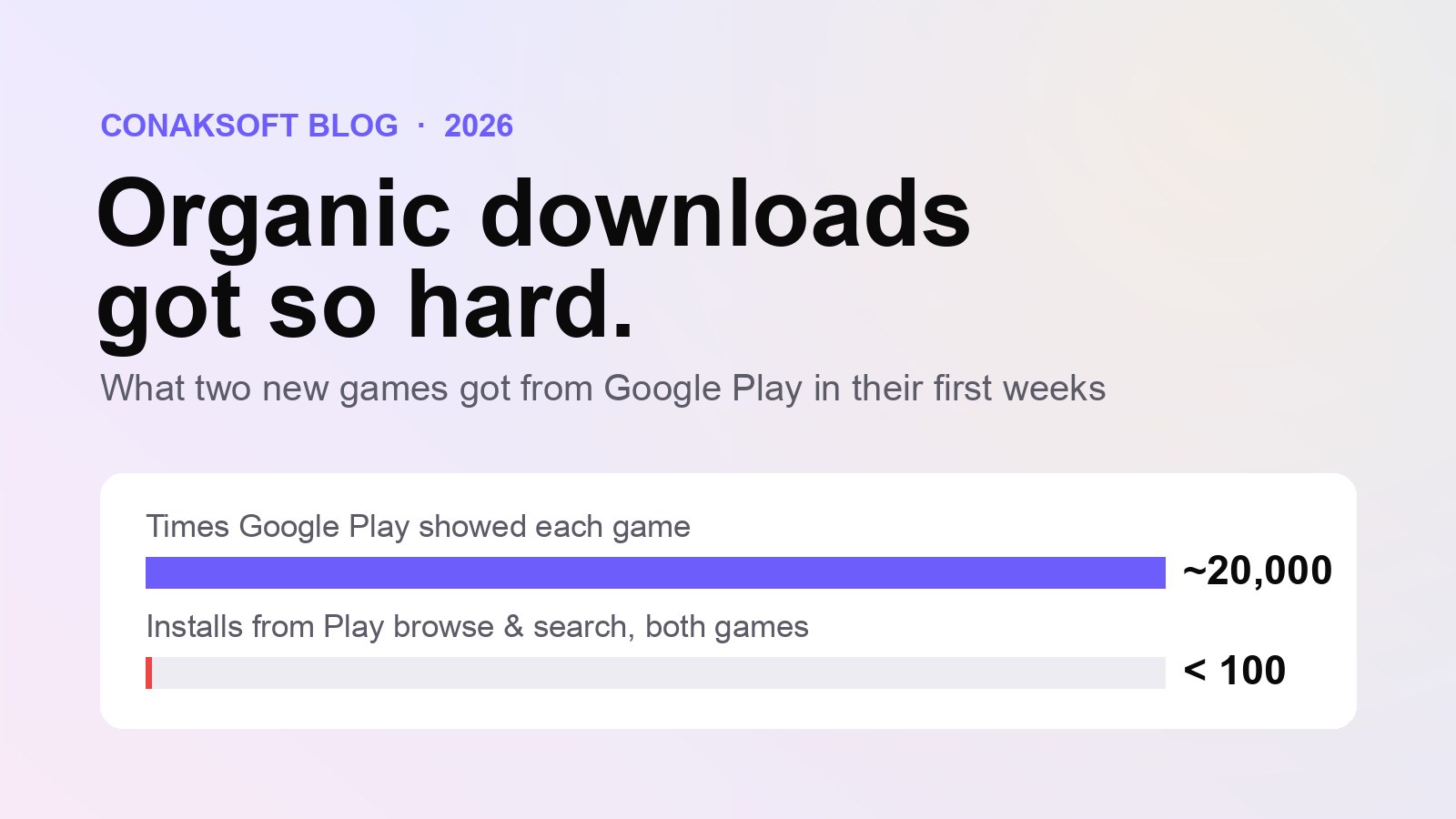
In October 2026 we released two casual games on Google Play: Hot Dog Street, a cooking game, and Idle Car Service: Garage Boss, an idle tycoon. Both launched with complete store listings, screenshots and descriptions. Here is what their first weeks looked like (numbers rounded):
| First weeks after launch | Hot Dog Street | Idle Car Service |
|---|---|---|
| Times Google Play showed the game | ~20,000 | ~18,000 |
| Installs | ~1,600 | ~140 |
| Installs from Google Play browse and search | ~70 | ~15 |
| Installs from ads and our own cross-promotion | ~90% | ~90% |
| Store listing conversion rate | ~35% | ~18% |
Three things stand out.
Google Play did show the games, it just didn't turn into installs. About 20,000 impressions each sounds like a lot. But the people who installed after finding a game on their own, through browse or search, numbered in the tens. Almost every install we got, we paid for or sent ourselves.
The store listing still decides a lot. The two games got almost the same exposure, but Hot Dog Street turned visitors into installs about twice as well. With paid traffic, a weak listing simply means you pay twice as much for every player.
An install is not a player. Only about half of the people who installed Hot Dog Street opened it, and fewer than half for Idle Car Service. If you buy installs, the first minute of your game is part of your marketing budget.
We have seen the exception too. One of our older apps still grows from search, because it sits on a search term with steady demand. When we later launched two more apps aimed at similar searches, they got almost nothing. Being early to a demand counts for far more than effort spent later.
What still works for organic downloads in 2026#
Organic growth is not dead, but it no longer happens by default. These are the levers we use, roughly in order of impact.
1. Check demand before you build#
Look at what people actually search for in the store, and how strong the apps ranking for those terms are. A great app in a category nobody searches for will not be found, and a crowded keyword will not let a newcomer in. If there is no realistic search term you can win, plan for paid acquisition from day one.
2. Treat the store listing as a product#
Most visitors decide from the icon, the first two screenshots and the first line of the description. Test them like you would test a feature: Google Play has store listing experiments and custom store listings, and the App Store has product page optimization. Our own numbers show a listing can double or halve what every visitor is worth.
3. Localize the listing, not only the app#
A translated title, short description and screenshots open search terms in other languages, where competition is often far lower than in English. You can localize a listing long before you localize the whole app.
4. Cross-promote between your own apps#
If you already have an audience, it is the cheapest traffic you will ever get. A well-placed card in one app, a post on your own channels or a reward for trying a new title costs nothing per install. For our new games, this worked hand in hand with paid campaigns.
5. Ask for ratings at the right moment#
Ratings affect both ranking and conversion. Use the native in-app review prompts, and trigger them after a good moment, such as a finished level or a successful task, never on first launch or after an error.
6. Keep the listing alive#
Regular updates, seasonal events and promotional content give the stores a reason to show your app again. Google Play lets you publish promotional content for events and offers, and the App Store has in-app events that appear in search and on your product page.
7. Own a page on the web#
A fast landing page for each app, with real content, can rank in Google search, collect links and send visitors straight to the store. It also gives press, partners and your own campaigns a place to point to. This is one reason we write this blog.
8. Ask to be featured#
Apple lets developers submit featuring nominations from App Store Connect, and Google Play runs programs for indie games in several regions. Most nominations go nowhere, but a single feature can deliver more installs than months of organic traffic.
When paying for installs makes sense#
For most new games, the honest answer is: always, at least a little. The questions are how much and where.
- Test small, in cheaper markets first. Adjust reports an average cost per install of about $0.14 in Latin America versus $1.68 in North America. A small campaign in a cheaper market shows whether people keep playing before you spend real money.
- Judge cost per retained player, not cost per install. If half of your installs never open the app, your real cost per player is double the number on the ad dashboard.
- Stop when the lifetime value is lower than the cost. Paid installs only work while a player earns you more, through ads or purchases, than you paid to get them.
- Combine paid with everything above. A better listing makes every ad cheaper, and every install from cross-promotion lowers your average cost.
The bottom line#
Thousands of apps launch every day into a market that has stopped growing, while competitors pay for more and more of the installs. Organic downloads still exist, but they go mostly to apps that are already known. For a new app or game, they are the exception, and usually the result of being early to a demand rather than of working harder. Plan your launch with a marketing budget and a strong store listing from the start, and treat organic installs as a bonus, not a plan.
If you are planning an app or game launch and want a team that has been through this, tell us about your project or see what we do.
Sources
- Testers Community, How many apps launch on Google Play each day (2026)
- Apple, 2025 App Store Transparency Report
- TechCrunch, Google Play sees 47% decline in apps since start of last year (April 2025, Appfigures data)
- PocketGamer.biz, Global mobile in-app purchase revenue hit $167bn in 2025 (Sensor Tower data)
- AppsFlyer, The State of Mobile Gaming for Marketers 2026, via Game Dev Reports
- Adjust, Gaming App Insights Report 2026, via Game Dev Reports
- Ju, Zhao and Aral, Advertising Spillovers in Mobile Apps: Evidence from Ad Shutoffs and Store Rankings (arXiv, 2025, revised 2026)
- Linkrunner, Mobile App Growth Benchmark Report 2026
- Apple Ads, App Store search and downloads
- Google, App testing requirements for new personal developer accounts
- Our own Google Play Console data for Hot Dog Street and Idle Car Service, October 2026